Caravan water at a glance
- Water mass
- Approximately 1 kg per litre for trip planning
- Worked tank capacity
- Two 90 L fresh-water tanks, 180 L in total
- Worked trailer allowance
- 2,800 kg ATM minus 2,400 kg tare = 400 kg nominal payload
- Full fresh tanks
- About 180 kg, using 45% of that allowance
- Days of supply
- Usable litres divided by your group's daily consumption
- Travel fill level
- Follow the tank/trailer instructions and check the loaded combination
- Storage
- Follow the model's water-system care instructions; full storage is not a universal rule
You weigh the caravan, then fill its fresh-water tanks on the way out of town. Unless the water was aboard at the weighing, you have just changed the load behind you. Tank position also matters: the same volume in a different tank can change how the load is shared between the coupling and axles.
Work out the supply you need and the mass you can carry. Keep the tank levels alongside your last weighing so you can compare departure with a known load.
The figures describe an illustrative caravan, not a particular make: 2,800 kg ATM, 2,400 kg stated tare and two 90 L fresh tanks. A 90 L tank is one available size from Jayco; your caravan's installed capacity and usable supply may differ.
How long does a caravan water tank last?
Divide the water available for normal use by the amount your travelling group uses each day. Keep the reserve outside that calculation rather than promising yourself the last litre.
Suppose your group uses 45 L a day across drinking, cooking, washing and other uses. That is a planning assumption for this example, not a recommended allowance per person. With 180 L available and no reserve set aside, the arithmetic is 180 ÷ 45 = four days.
If you set aside an illustrative 20 L reserve, normal use has 160 L available: 160 ÷ 45 = about 3.6 days. Choose your actual reserve for the route and conditions. A four-day plan needs a verified refill or a different water budget under that assumption.
| Water aboard | Supply at an assumed 45 L/day, before reserve | Approximate water mass |
|---|---|---|
| 80 L | 1.8 days | 80 kg |
| 120 L | 2.7 days | 120 kg |
| 180 L | 4 days | 180 kg |
| 240 L | 5.3 days | 240 kg |
These rows compare volumes, not standard tank packages. The worked caravan holds 180 L in its two fresh tanks. Carrying 240 L would require additional suitable capacity and another loading check.
Use a short trip to establish your own consumption. Record the starting volume, any refills and what remains. Note whether you used campsite showers or your own, because a different routine changes the next estimate. A gauge reading is a useful observation, but the nominal tank capacity alone does not tell you the usable volume left.
How much does caravan water weigh?
For loading calculations, use approximately 1 kg per litre. Water density varies slightly with temperature and composition; the US Geological Survey's water-density explanation gives the underlying relationship. The rounded conversion is useful for a packing estimate, which you then check against measured weights.
Our caravan's nominal payload is 2,800 − 2,400 = 400 kg. Filling its two empty 90 L fresh tanks adds about 180 kg. That uses 45% of the allowance and leaves 220 kg for everything else absent from the stated tare.
| Worked caravan, starting from stated tare | Mass or allowance |
|---|---|
| ATM rating | 2,800 kg |
| Stated tare | 2,400 kg |
| Nominal payload | 400 kg |
| Water added to two empty 90 L tanks | Approximately 180 kg |
| Allowance for other additions after that fill | Approximately 220 kg |
Water in the caravan belongs in its Aggregate Trailer Mass check. A bladder or jerry can carried in the ute belongs in the ute's Gross Vehicle Mass check, including the relevant axle load. Moving water from the caravan into the vehicle changes where the load sits; it does not remove mass from the combination.
The HiLux towing guide shows how a canopy, equipment and hitch load share a ute's carrying allowance. For a touring wagon, the Patrol guide puts passenger and luggage loads beside the caravan load. These are different packing decisions from choosing a tank size.
Count water once as it moves through the caravan
Water transferred from a fresh tank into an onboard waste tank largely remains aboard. If 40 L leaves a fresh tank and collects in a grey tank, do not add a new 40 kg to the total as though it came from outside. Its position has changed; the transferred water's mass has not been created again.
A refill adds water to the rig. Discharging water removes it. Record fresh and waste volumes at the weigh-in and at departure so that later calculations start from the same condition. The caravan weights guide explains the vehicle, trailer and combination checks that use those loads.
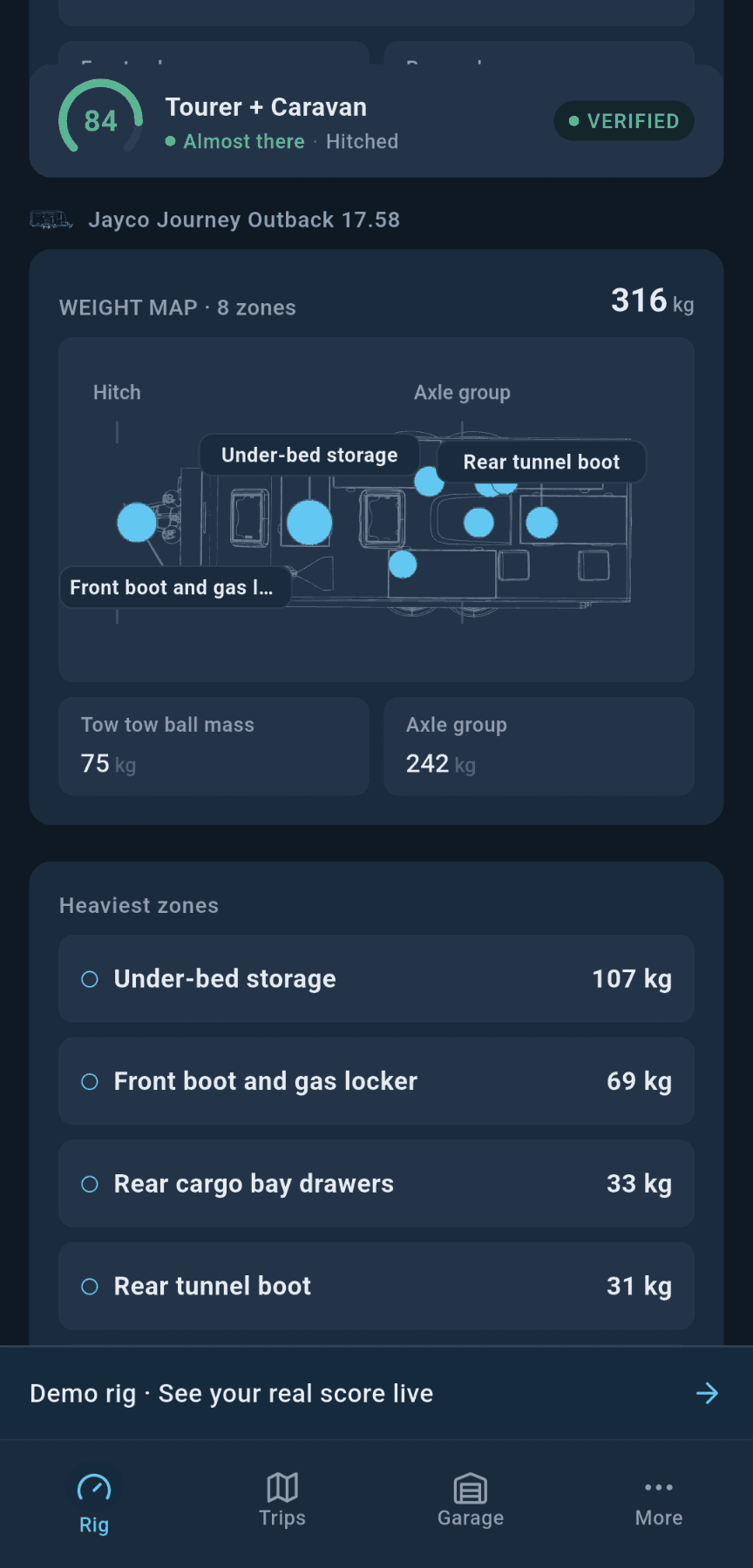
Record a refill as a change to the load
If you leave with 60 litres and refill to 150 litres, add about 90 kg to the water load recorded in loadmate. The load map helps you track where that extra weight sits in your rig.
Example app screen. The values shown belong to the example rig.View the full-size app screen


What size caravan water tank do I need?
Choose capacity from the longest planned gap between reliable refills and the payload available to carry the supply. Multiply your estimated daily use by that gap, then add your chosen reserve. Compare the result with usable installed capacity.
For the 45 L/day example, four days of ordinary use consumes the full 180 L before any reserve. More tank capacity would provide room for extra water, but a full extra tank would also consume carrying capacity. Include new tank brackets, pumps and plumbing if they are absent from your existing measured baseline.
Before a retrofit, ask the caravan manufacturer or installer to confirm the mounting, operating limits and effect of the proposed position. Record which tanks are forward or behind the axle group. Do not assume the 280 kg ball load from one full-tank weighing remains 280 kg with a different tank arrangement or fill level.
How do you make water last when free camping?
Start with the uses you can measure and adjust without relying on an advertised number of days. Keep enough supply for drinking and the other needs of your route; water-saving changes should improve the budget rather than hide a shortfall.
In the kitchen
Scrape food from plates before washing them. A measured basin makes washing-up use easier to track than a continuously running tap. Include cooking water in the same daily tally, including water discarded after cooking.
Personal hygiene
Measure what a shower uses with your own showerhead and routine. If campsite facilities are part of the plan, confirm they will be available. Recalculate when the trip changes from serviced sites to a remote camp.
Cooking techniques
Plan meals with the available water supply in mind. Preparing ingredients before departure and using fewer pans can reduce washing-up. Record the difference on a trip before building a longer stay around it.
Clothes and cleaning
Allow for laundry or choose a stop where it can be done. Include cleaning water you normally forget to count, rather than treating drinking-water use as the whole budget.
Upgrades that save water
Check the stated flow and operating requirements of any replacement tap, shower or appliance. Compare the expected saving with your measured routine. An additional tank increases storage capacity; whether it extends the trip depends on how much water your rig can carry and use.
What are the grey water rules?
Check the conditions for the particular campsite before choosing a waste-water setup or discharging anything. Ask the operator or land manager where disposal is permitted and what equipment their self-containment requirement accepts.
A portable container may suit some arrangements, but its capacity alone does not establish acceptance at a self-contained site. Confirm requirements before arriving. Plan the return leg too: waste water retained aboard remains part of the departure load even when the fresh-water gauge has fallen.
Should you travel with tanks full or empty?
Follow the caravan and tank manufacturer's travel instructions, then carry the supply your route needs within the rig's limits. There is no single full-or-empty answer for every tank and caravan.
| Your situation | Check before departure |
|---|---|
| Reliable refill close to camp | Confirm access and opening arrangements, then calculate the supply needed to reach it |
| A long stretch without water | Budget the complete leg and reserve, then verify that the load fits |
| Several tanks in different positions | Record each fill level and check the corresponding ball and axle loads |
| A partially filled tank | Follow its travel instructions, including any restrictions related to the tank design |
Tank shape, baffles and position affect how water behaves. Extra water also changes the total load. A low-mounted tank or a favourable trailer-to-vehicle weight ratio does not, by itself, establish a safe fill level. If the manufacturer does not give enough information for your setup, ask before relying on a generic rule.
For an illustrative fully loaded condition, this caravan weighs 2,800 kg with its fresh tanks full and has a measured 280 kg ball load with weight distribution inactive. Its trailer axle load is then 2,520 kg. If a coupled tow vehicle weighs 3,050 kg, the combination is 3,050 + 2,520 = 5,570 kg. Against an illustrative 5,950 kg GCM, the margin is 380 kg. Those readings describe that load condition only; changing tank levels needs an updated check.
How do you keep tank water fresh?
Use the water-system care instructions for your caravan, including its storage procedure. Travel quantity and long-term storage are different decisions.
Storage and cleaning
Jayco's winter storage guidance calls for draining water systems before storage, and its winterisation and long-storage instructions give the procedure. Apply the instructions for your model rather than keeping every caravan tank full by default.
Follow the system and cleaning-product directions for draining, cleaning and returning the system to service. Check the water heater and other appliances separately before operating them.
Sourcing water on the road
Confirm that a fill point supplies drinking water if that is what you intend to use it for. Plan an alternative if access or availability is uncertain. A location pin alone does not confirm today's supply or its suitability.
Leaks, cold weather and an emergency reserve
Check the plumbing for leaks before relying on the stored volume. Follow the manufacturer's cold-weather procedure where freezing is possible. Keep your selected reserve in the trip budget and remember that separately carried containers also count towards the relevant vehicle or trailer limits.
See what a full tank does to your limits
Your last weigh-in might represent full fresh tanks and an empty grey tank. The return journey may carry the water in a different place, with a refill and changed gear aboard. Keep those conditions with the weighing rather than relying on its total alone.
loadmate connects the water quantities and load positions you record with the rig's limits and measured baseline. Explore loadmate in the app to review how a planned fill or a later load change affects the combination. The record depends on the quantities you enter; it does not measure the tanks automatically.
loadmate provides decision support for towing safety. Use measured weights and the manufacturer's requirements to check your setup. See the safety disclaimer.
Related guides
- Caravan and towing weights: understand which part of the rig carries each load
- Aggregate Trailer Mass: separate the trailer rating from today's measured load
- Gross Vehicle Mass: include water carried in the vehicle
- When to reweigh a caravan: review changes since your measured baseline
- HiLux towing capacity: ute accessories and carried water alongside hitch load
- Patrol towing capacity: touring-wagon passenger, luggage and trailer allowances
- Towing capacity by vehicle: find your model's guide
Frequently asked questions
- How long does a 180 L caravan water tank last?
Divide usable water by your group's daily consumption. At an assumed 45 L a day, 180 L lasts four days before a reserve. That is an illustrative budget, not a typical-family guarantee. Measure your own use before planning the next trip.
- How much does a full caravan water tank weigh?
Allow approximately 1 kg for each litre. Two full 90 L fresh tanks hold about 180 kg of water. Count the tank hardware separately if it is absent from your starting weight, and do not add water already included in a weighing twice.
- How many litres do I need per person each day?
Use your travelling group's measured consumption, including drinking, cooking, hygiene and appliances, then allow for the route and a reserve. A fixed per-person figure cannot account for different routines and facilities.
- What size tank do I need for free camping?
Multiply the group's expected daily use by the days between reliable refills, then add the chosen reserve. Check that your installed usable capacity and the rig's remaining payload can accommodate that supply.
- Can caravan grey water drain onto the ground?
Confirm the particular campsite's disposal conditions with its operator or land manager. Ask where discharge is permitted and what self-containment equipment is accepted. Retained waste water still forms part of your loaded rig.
- Should tanks be full or empty when towing?
Follow the tank and caravan manufacturer's travel instructions. Choose the quantity for your route and verify the resulting total, ball and axle loads. A blanket prohibition on every partially filled tank does not account for different tank designs.
- Does tank water count towards ATM?
Water carried by the caravan forms part of its actual loaded mass, which you compare with the ATM rating. Water in the tow vehicle belongs in its vehicle and axle checks. Both contribute to the combined mass.
- Should I drain caravan water tanks for storage?
Follow the model's storage instructions. Jayco's published winter storage guidance directs owners to drain the water systems. That is a reason to check your own manual, rather than assume all tanks should be stored full.